
Stories
Water, stories, the body, all the things we do, are mediums that hid and show what's hidden. Rumi

story(n.2)
“stage or subdivision of the height of a house, habitable space between a floor and a ceiling of a building,” c. 1400, storie, also used of the external walls, from Anglo-Latin historia “floor of a building” (c. 1200), also “picture,” from Latin historia (see history).
Story - Etymology, Origin & Meaning
Magic and shape shifting shaped the first stories. Does this sound familiar, the first stories were of shape shifters acrosss continents known Shamans. Humans have a capacity of curioisity and magic. Now it is AI, before that it witches and before that it was Gods but before everything was the supernatural. Cave paintings and etchings with Shamans. It is in every part of the world. We have been trying to find meaning and warnings. No wonder society is so paranoid as evidenced below.
The very first story is in
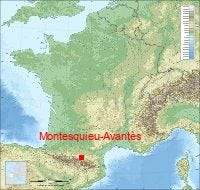
Very close to the French town of Montesquieu-Avantés, in the Midi-Pyrénées region, and to the Tuc d’Audoubert cave with its fantastic prehistoric clay bisons, is the cave of the Trois Frères (Three Brothers).
Both are part of an underground system of three caves formed by the river Volp (the third one is the Enlène cave). The cave of the Trois Frères, 430 metres deep, is the richest in cave art, consisting of paintings and engravings from the Magdalenian period (17000-10000 BC).
The World's First Stories - The Human Journey
The strange and controversial prehistoric ‘sorcerer’ of the Cave of the Trois Frères
It was discovered by Count Henri Bégouen’s three children (Max, Jacques and Louis, plus two friends) in 1914 (hence its name), who two years earlier had also found Tuc d’Audoubert’s. And like this one, it was studied by the archaeologist and clergyman Henri Breuil, a pioneer in the research of Palaeolithic art and the first professor of prehistory at the Collège de France, between 1920 and 1938.
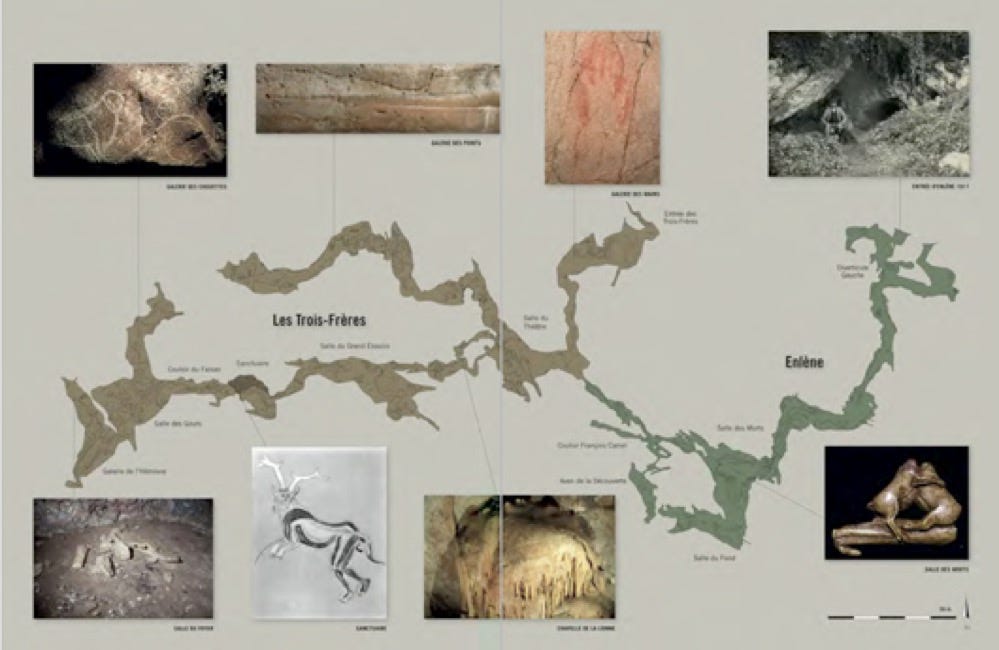
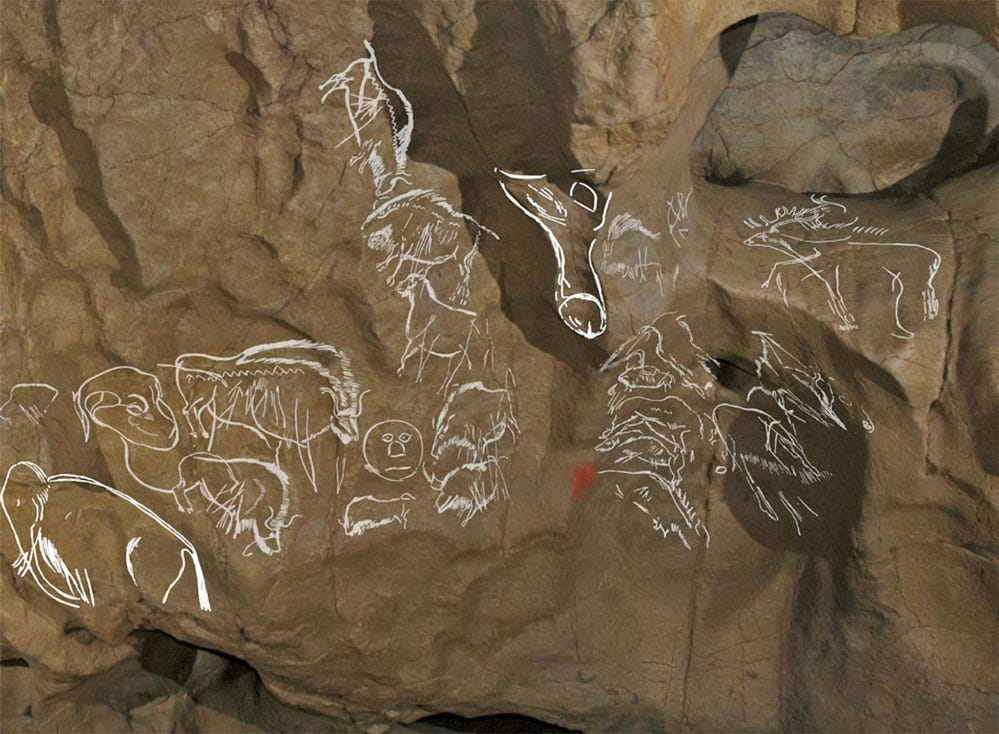
Breuil identified some of the most singular and significant representations of Palaeolithic art among the paintings and engravings in the cave. Firstly, up to seven anthropomorphic or therianthropic figures (half human-animal). In addition, on a fragment of bison bone, he found the image of a grasshopper, today considered the first known representation of an insect.
Moreover, there are several engravings of animals such as lions, owls and bison, a horse covered with claviform symbols, and a strange bear pierced by a kind of spear vomiting blood.
Breuil made drawings of all this, which became popular all over the world thanks to the wide circulation of his publications. A more detailed study, accompanied by hundreds of drawings, was published in 1958 by Breuil himself and Bégouen. And in 1967 the first photographic study was carried out. A total of some 350 figures were counted: 84 horses, 170 bison, 20 ibexes, 40 reindeer, 8 bears, 6 felines, 2 mammoths, 1 rhinoceros, 6 birds, 7 anthropomorphic figures, 5 hand prints, and numerous symbols and abstract signs.
Of all the representations, the one that interests us here is the one called The Sorcerer. It is located in one of the small interior cavities known as the sanctuary, whose walls are covered with some 280 (the cavity that contains the most of all) superimposed drawings and engravings of reindeer, bison, horses, goats, bears, mammoths and anthropomorphic figures. Above them, about 4 metres high from the base of the cave and dominating the whole, the Sorcerer appears.
It represents a human figure, but with features of other animals, although its characteristics remain controversial. Let’s see why.
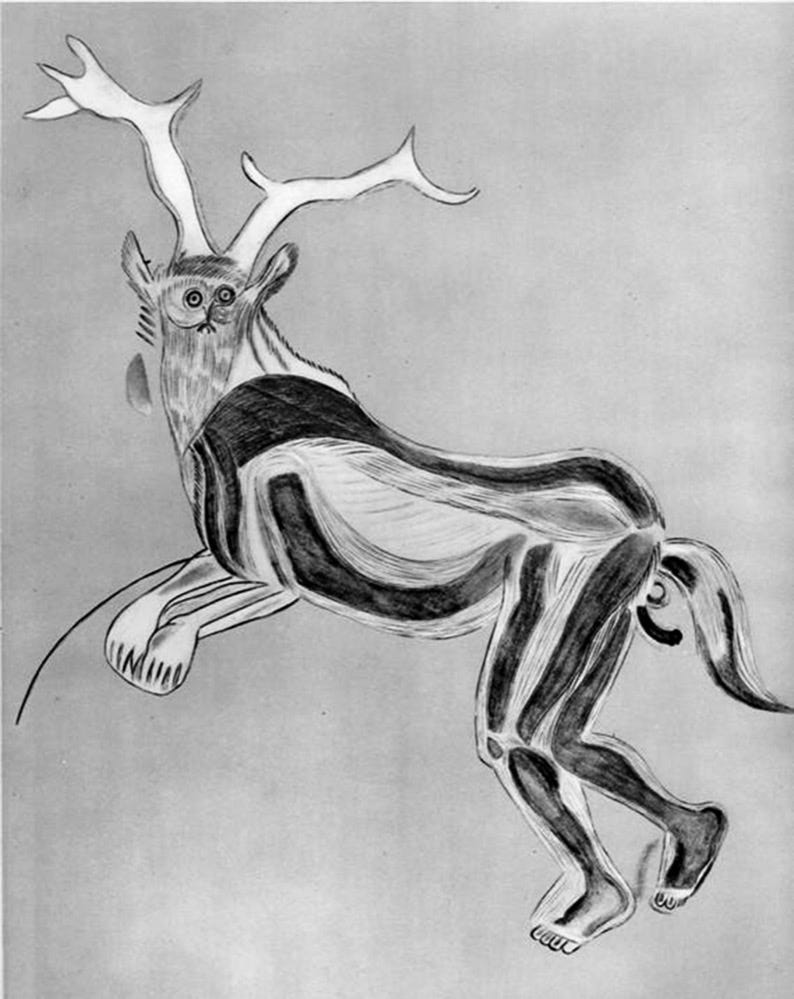
Breuil studied and drew it during his early research in the 1920s, and its publication soon made it one of the most famous examples of European prehistoric art. In his detailed drawing he depicted an anthropomorphic being, with human legs, bear feet, horsetail, deer antlers, bison beard and owl eyes.
The Budj Bim Creation Story May Be More Than 30,000 Years Old
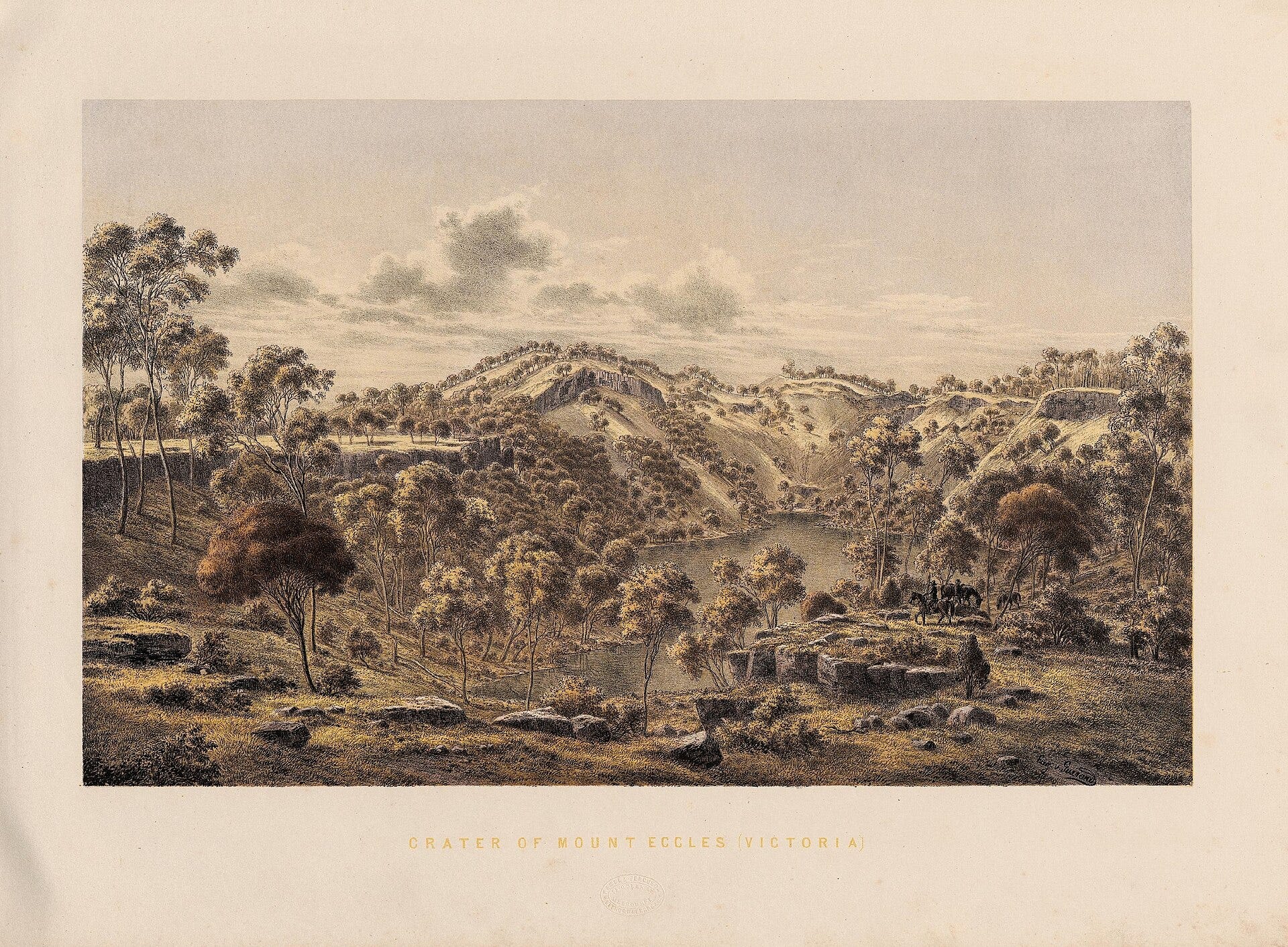
Which brings us to the creation story of Budj Bim. According to the Gunditjmara people of Southwest Australia, a god named Budj Bim emerged from the earth in the form of a volcano, his head becoming the rocky protuberance, his teeth forming the basalt deposits, and his blood spilling over the land as lava. The volcano still exists, albeit in dormant mode as a feature of the Gunditjmara ancestral lands, now known as the Budj Bim Cultural Landscape.
In the 1940s, an artifact known as the “Bushfield axe” was found beneath a layer of ash from the Tower Hill volcano complex, located about 25 miles from the Budj Bim complex. More recently, thanks to advancements in radiocarbon dating, scientists were able to determine that both Budj Bim and Tower Hill last erupted more than 30,000 years ago.
Since the axe was found beneath the ash, it stands to reason that people inhabited the region at the time the volcano erupted. As such, the local Dreamtime myth about the lava-spewing god that changed the landscape may also be more than 30,000 years old.
Australian Aboriginal mythology | Religion and Philosophy | Research Starters | EBSCO Research
What Is the World’s Oldest Story? - History Facts
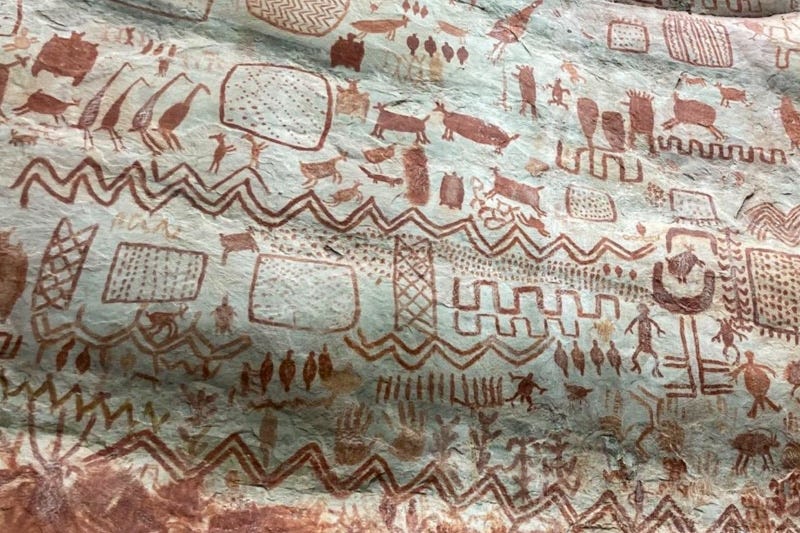
Shamans in the Ancients world
Through collaboration with local Indigenous communities such as the Tukano, Desana, Matapí, Nukak, and Jiw, the archaeologists found that the collection of ancient paintings was not simply a record for environmental observations. Instead, they found that the rock motifs convey a hidden spiritual dimension that shamans navigate by transforming into animals.
This concept, a part of Indigenous Amazonian cosmology, suggests that the physical body acts as an outer shell concealing the true essence of a living being. Shamans shed their physical identities to enter a spiritual realm where the boundaries between species dissolve, allowing them to connect with the deeper essence of other forms of life.
This interpretation of ritual transformations is supported by multiple scenes depicting therianthropic figures—humans transforming into snakes, jaguars, or birds This conclusion would not have been possible without the help of the Indigenous elders, who were able to aid the researchers in understanding the true spiritual significance behind these images.
“It is the first time that the views of Indigenous elders on their ancestors’ rock art have been fully incorporated into research in this part of the Amazon,” said Jamie Hampson, one of the lead researchers and authors of the study, in a statement to the University of Exeter. “In so doing, it enables us to not simply look at the art from an outsiders’ perspective and guess; we know why specific motifs were painted, and what they mean.”
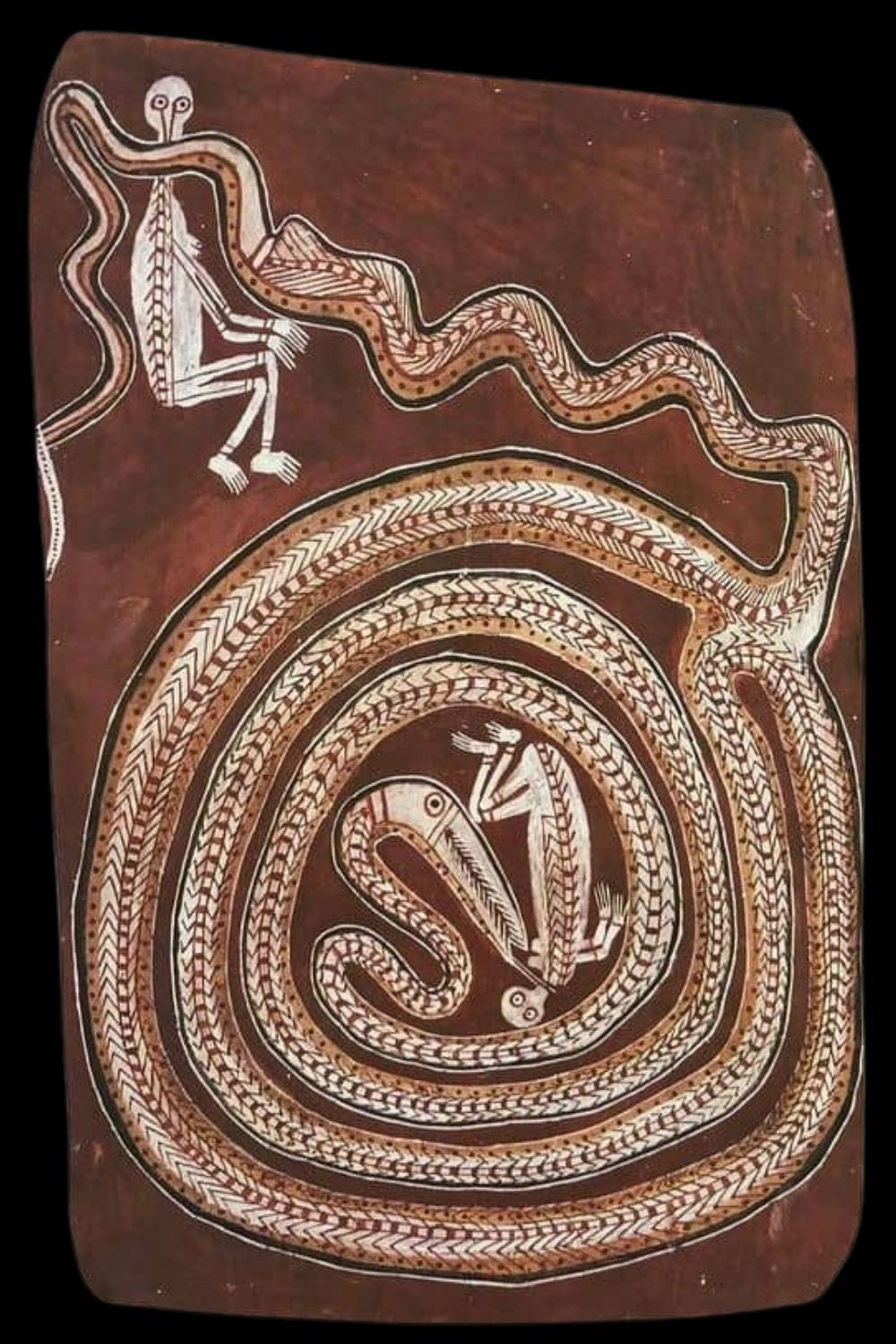
The Rainbow Serpent from Dreamtime
Dreams really do matter.
In the first time, when the land lay flat and silent beneath the sky, the world had no rivers, no mountains, and no waterholes. Everything slept beneath the earth, waiting. Deep below the surface, the great Rainbow Serpent rested—vast and powerful, her body holding the colours of storm, water and light. For a long time she lay still. Then, as the time of creation came, she began to move.
The earth trembled.
She pushed upward, breaking through the surface, and began to travel across the land. As she moved, her great body carved deep paths into the earth. These became the first rivers. Where she turned, the rivers bent. Where she rested, the ground sank and filled with water, forming billabongs and waterholes. Where she pressed down with force, hills and ridges rose up around her. The land took shape in her wake.
As the Rainbow Serpent travelled, she brought water with her. It flowed into the channels she had made, filling the country with life. Plants began to grow, trees took root along the riverbanks, and animals emerged to drink and move across the land. Birds filled the sky, fish swam through the new waters, and the world awakened.
The Rainbow Serpent watched over this new creation. She gave each living thing its place and its way of being, teaching people how to live with the land—where to find water, how to gather food, and how to respect the places she had formed. Some places were open, but others were sacred.
These were the first laws of the land.
https://www.aboriginal-bark-paintings.com/rainbow-serpent/#:~:text=In%20the%20first,of%20the%20land.
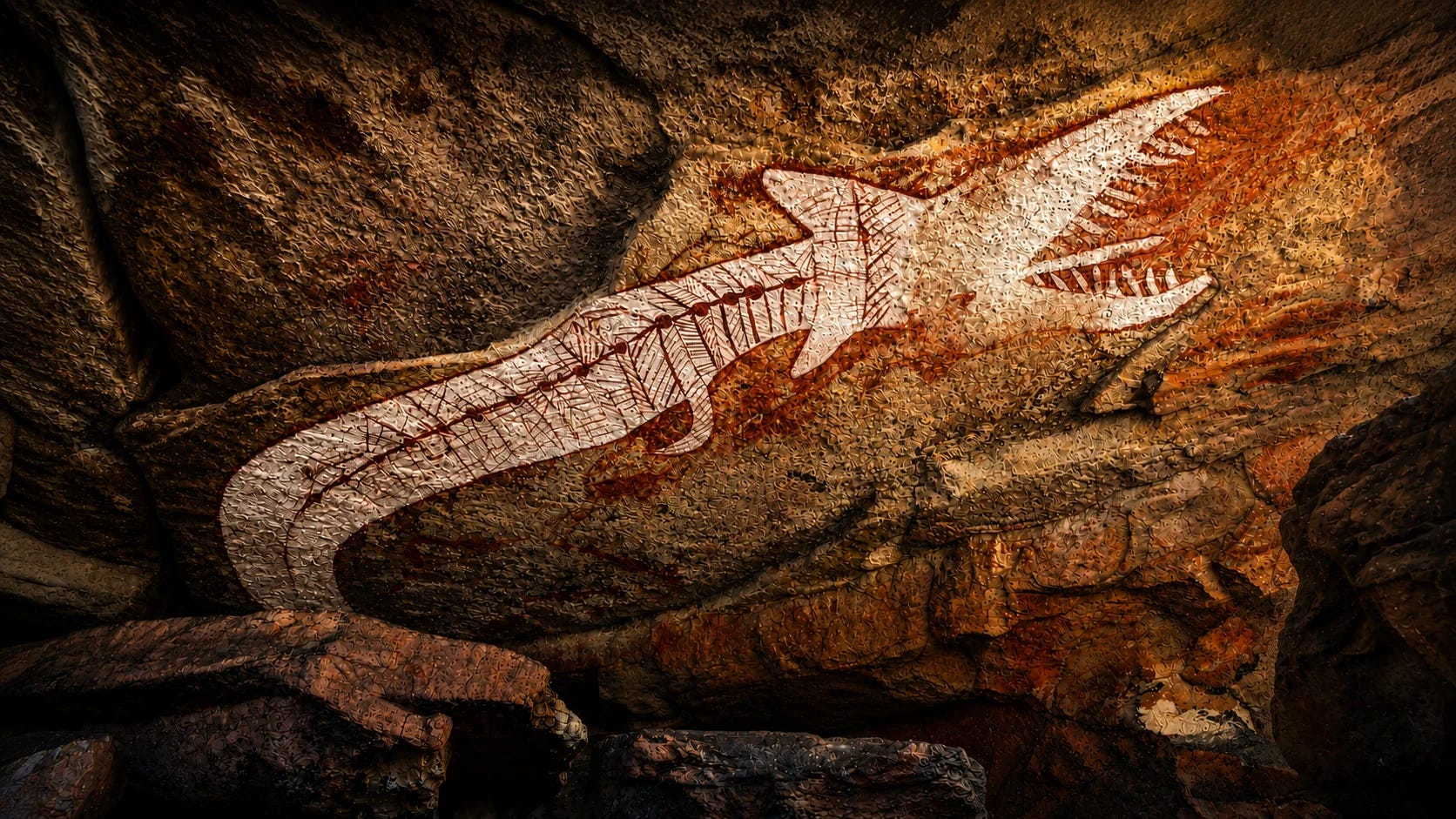
Stories are part of who we are as people from the ancient beginnings to modern things. Some things don’t change, they evolve. Writers will always have a place to write even if it is on a computer screen.
Never forget. Animals are sacred and there are shape shifters and magic.
Some things should stay buried and some things are always there.